
Search is evolving. Users are leaving behind traditional searches like clicking links on Google. Instead, they are interacting with ChatGPT, Perplexity, and reading Google AI Overviews, often without going to a website. If your brand is absent from AI generated answers, customers are leaving before they reach your website. Generative engine optimization services solve these concerns.
What Is GEO?
The acronym GEO stands for Generative Engine Optimization. It is the process of shaping the content your brand provides so that AI powered search engines cite your brand as a source.
generative engine optimization definition provides a new way of thinking about content. Instead of getting a rank in the blue links of Google, your content is mentioned in AI answers of ChatGPT, Perplexity, Gemini, and Google AI Overviews.
GEO meaning important for businesses. It helps your brand become the content that AI engines pull to answer the questions your audience is asking about your products and services.
What Is Generative Engine AI?
Generative engine AI are the tools that, in response to a query, provide answers in a format that is direct and conversational as opposed to a list of links.
The current leading platforms of AI search are:
- ChatGPT – 180 million+ monthly active users
- Perplexity – increased 858% in usage in the last year
- Google AI Overviews – answers millions of searches a day
- Gemini – integrated into Google Search
- Claude – rapidly growing in both research and professional environments
These platforms do not rank. They cite. For your content to be cited it must be clear, authoritative, and easy to read. This is the final step in optimization for generative engine AI.
What Is Generative SEO and How Is It Different from Traditional SEO?
This term refers to the next stage of search optimization, this time with a focus on the answer-focused AI rather than traditional search result pages. Generative SEO, or GEO for short, focuses on applications such as ChatGPT, Perplexity, and Gemini, rather than the traditional Google blue links.
This is how traditional SEO and Generative SEO differ:
| Factor | Traditional SEO | Generative SEO (GEO) |
| Target platform | Google, Bing | ChatGPT, Perplexity, Gemini |
| Goal | Rank in blue links | Get cited in AI answers |
| Content focus | Keyword density | Entity clarity + direct answers |
| Key signals | Backlinks, page speed | Authority, structure, credibility |
| Result format | Link listing | Conversational AI response |
| Measurement | Rankings, CTR | AI citation frequency |
What Do Generative Engine Optimization Services Include?
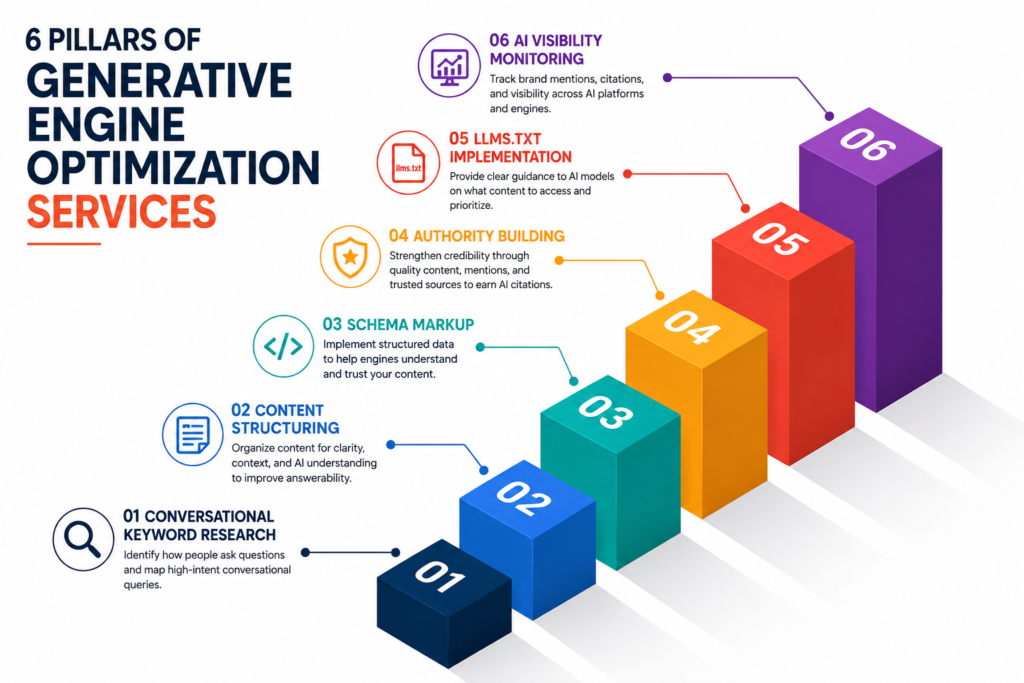
Professional generative engine optimization services cover six core areas:
1. Conversational Keyword Research
While traditional keyword research consists of keyword lists, GEO uses long-tail keyword phrases that are questions. For example, an SEO service search may look like, “which SEO service is best for small businesses?” instead of just “SEO service.”
2. Content Structuring for AI Parsing
Each page must have concise answers to questions about the AI engine within the first few words. Above this answer are several brief paragraphs with detailed H2 and H3 headings. FAQ sections and bullet points are also popular.
3. Schema Markup and Structured Data
There are many such types of schema, like FAQ schema, HowTo schema, Organization schema, Product schema, etc. These schemata tell AI systems what is on your pages. Generative engine optimization is more than content. This includes sending technical signals to AI engines that your brand is organized, credible and worthy of citation. This completes Technical SEO Services to create the required AI ready framework.
4. Authority and Citation Building
AI engines trust brands that are cited across authoritative sources. These include Reddit, Quora, and LinkedIn, as well as industry-related and News publications. Establishing this presence is one of the most important aspects of building a GEO strategy.
5. llms.txt File Implementation
An llms.txt file informs AI systems which pages on your site you consider to be the most important. For a more comprehensive overview, Read the full guide on what is llms.txt. This is one of the most effective technical solutions for GEO.
6. AI Visibility Monitoring
This involves analyzing the frequency of your brand’s visibility in AI responses over the following platforms and adjusting your strategy accordingly on a monthly basis. These platforms include ChatGPT, Perplexity, Gemini, and Claude.
Why Your Business Needs GEO Right Now
There are clear signs that traditional search is declining.
- Gartner predicts a 25% decline in traditional search by 2026.
- 70% of users trust searches with AI.
- 79% of users intend to enhance their searches with AI in the next 12 months.
- Predictions show that organic traffic to websites will decline by over 50% because users will no longer be required to click links.
For businesses looking to scale visibility across channels, this guide on Shopify SEO strategies shows how content optimization and authority building work together to drive real results.
Who Needs GEO Services?
Generative Engine Optimization will work the best for:
- E-commerce Stores — Customers ask AI what is the best product for X before they even purchase.
- Service Businesses — Users ask what agency should they hire for Y.
- B2B Companies — Executives use AI to research and compare companies.
- Local Businesses — AI will recommend businesses that are nearby for location-based queries.
- Healthcare and Finance businesses — These are high-trust topics, and AI citations are critical.
How to Start with GEO: 6 Steps
Step 1 — AI Visibility How visible is your business on AI? Ask ChatGPT and Perplexity questions related to your business and see what gets cited. If your business gets no citations, that is your visibility gap.
Step 2 – Restructure Your Most Important Pages All pages should start with a direct answer. Incorporate FAQ Sections. Use short paragraphs under concise headings.
Step 3 – Add Schema Markup Use FAQ schema and Organization schema first. Combine with Technical SEO Services so AI crawlers will index every page properly.
Step 4 – Build Citations on AI-Friendly Platforms Post useful information on Reddit, Quora, LinkedIn, industry blogs. These are the primary sources that AI engines pull from.
Step 5 – Implement llms.txt Add an llms.txt file to help direct AI Crawlers to your more important pages.
Step 6 – Track and Optimize Citation from AI services should be monitored. Refresh old content. GEO is a perpetual process.
Frequently Asked Questions
Q1 What are generative engine optimization services?
The GEO acronym is focused on the citation of digital content to AI answer engines. Techniques place an emphasis on the clear structure and entities of digital content more than keyword saturation.
Q2 What is the GEO meaning in digital marketing?
GEO meaning is about strategies that help your content be citable by AI answer engines. The focus being on structure, clarity of entities, and authority as opposed to keyword density.
Q3 What is generative SEO vs traditional SEO?
What is generative SEO in simple terms — it targets AI answer engines instead of Google blue links. Both are needed in 2025, but GEO needs more content formatting, schema markup & citation building.
Q4 What is the generative engine optimization definition?
The generative engine optimization definition is the process of formatting and building authority for your content so AI platforms like ChatGPT and Perplexity cite your brand when answering user queries.
Q5 What is GEO and how long does it take?
GEO in terms of timeline — initial improvements appear in 2 to 4 weeks. Consistent citation growth takes 3 to 6 months of regular optimization.
Conclusion
AI searches are already prevalent. Hundreds of millions of people receive quick responses from tools such as ChatGPT, Perplexity, and Google AI Overviews without the need to click on a single link. The only way to ensure your brand is still visible during these modifications is through Generative engine optimization services. Once you have authority signals, the correct structure and schema, coupled with the right techniques, your brand will become the go-to sought and cited source by AI search tools.