
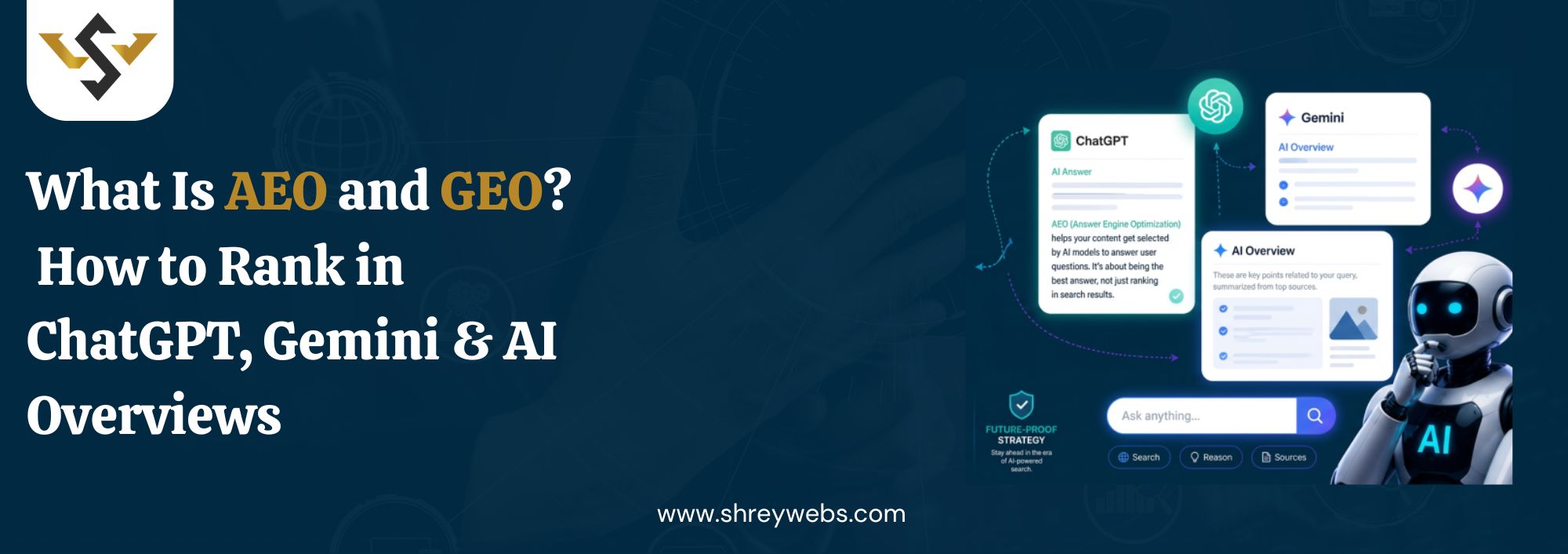
Search habits have shifted more in the past two years than the ten before that. Fewer people scroll through ten blue links anymore. They ask ChatGPT a question, check Gemini for a summary, or read the AI Overview above Google’s normal results. That’s why aeo and geo have become such a common phrase in marketing conversations. Skip these two, and a chunk of your audience won’t find you, even if your regular rankings look fine.
SEO used to mean one thing: climb the results page. That page still matters, but it isn’t the only game anymore. AEO and GEO now decide whether your business gets named when someone asks an AI assistant “who’s the best plumber near me.” Ranking well inside AI Overviews, ChatGPT, and Gemini means treating aeo and geo in seo planning as one strategy, not a side project.
Before we get into tactics, it’s worth separating the two terms. We’ve covered What Is GEO in a dedicated guide already, but here’s a quick refresher on how the two fit together.
What Is AEO?
Answer engine optimization is about structuring content so it can be lifted straight out and used as an answer, whether that’s a Google featured snippet, a voice reply, or an AI Overview. AEO content tends to be short and to the point, usually a clear question followed by a tight answer. The “answer engine” is scanning for something quotable and factual, and it moves on fast if it can’t find that.
What Is GEO?
Generative engine optimization asks for something different. AEO wants to be the answer. GEO wants to be cited inside a longer, generated answer, the kind ChatGPT, Gemini, or Perplexity produce when they pull from several sources and stitch together a response. Not every source makes the cut, only the ones the model trusts. That’s why aeo and geo in seo strategy work best as a pair: one wins the answer box, the other earns the citation.
AEO vs GEO at a Glance
| Factor | AEO | GEO |
| Goal | Win the direct answer box or snippet | Get cited inside AI-generated responses |
| Content style | Short, direct, question-based | Detailed, well-structured, source-worthy |
| Platforms | Google featured snippets, voice search | ChatGPT, Gemini, Perplexity, AI Overviews |
| Ranking signal | Clarity and directness | Authority, structure, and citations |
| Best format | FAQs, definitions, how-tos | Guides, comparisons, data-backed articles |
Once you see geo and aeo as connected but different jobs, the rest gets easier. Most sites aren’t doing either well yet, which is good news if you start now.
AEO and GEO Services
We run AEO and GEO Services built to get your brand cited inside ChatGPT, Gemini, and Google AI Overviews, not just parked on page one. That means structuring content for direct answers and backing it with enough authority that generative engines actually trust it. If you’re weighing AEO and GEO Services for the first time or tightening up what you already have, the goal is the same: show up when someone asks an AI a question you can answer.
Why AEO and GEO Matter for Ranking in AI Overviews
Google’s AI Overviews, ChatGPT, and Gemini work in roughly the same way. They crawl the web, pull out the parts that seem trustworthy, and stitch a response together on the fly. If your content isn’t built for that kind of extraction, you’re simply left out of the answer. A few habits go a long way:
5 Fundamentals for LLM Visibility
- Answer the actual question within the first two sentences
- Use headings that sound like how people search, not a brochure
- Back claims up with real numbers instead of vague statements
- Use bullet points, tables, and FAQs, since models can lift them easily
- Keep your brand name and location consistent across every page
AEO or GEO: Which Should You Prioritize First?
Almost every business asking “what is aeo and geo” ends up asking the same follow-up: which one first, and what’s it going to cost? The real difference between aeo and geo comes down to speed versus depth. AEO gets you noticed fast through snippets. GEO builds the kind of authority generative engines lean on later. Either way, it helps to know the numbers first, and our SEO Cost in India guide is a decent place to start.
How to Build a Content Strategy Around AEO and GEO
Read your own content the way an AI Overview would. Cut the throat-clearing intros and get to the point within two lines. Break up long paragraphs, and add FAQs that match what people actually type into a search bar. That one habit alone moves aeo and geo performance faster than most technical fixes.
How to Measure Success
The difference between aeo and geo shows up again once you measure results. AEO wins are easy to spot right away, a snippet or voice answer appears and you know it worked. GEO wins are quieter. AI tools don’t hand over clean source data, so you’re left watching for branded mentions inside ChatGPT and Gemini.
5 Priorities to Revisit Regularly
Once the basics are covered, come back to these every so often, since the models keep changing:
- Update stats and examples every few months so they stay worth citing
- Add original research or client results wherever you have them
- Tighten internal linking so crawlers understand what your site is about
- Write for natural questions people ask, not just short-tail keywords
- Track which pages already get cited in AI answers, then build on those
Get this right and aeo and geo in seo terms stop being two separate checklists. Treated as one strategy, they hold up better over time than chasing rankings alone.
Why Local Businesses Should Care
Local businesses have a lot riding on this shift. AI tools are increasingly the first stop for location questions, and the difference between aeo and geo can decide whether you show up for something like “best digital marketing agency in Ahmedabad.” Solid on-page basics paired with citations elsewhere on the web, including a piece like our Strategies to Improve Online Visibility article, gives generative engines more reason to trust what you’re saying.
Conclusion
AI Overviews, ChatGPT, and Gemini aren’t a side channel anymore. For a lot of users, they’re the first place a question goes. Treat aeo and geo as a real part of your SEO plan, not something to get to later. Write clearly, back it up with real substance, and you’ll start turning up in the answers people are actually reading.
FAQs
Q1. What is AEO and geo in simple terms?
AEO wins direct answers and snippets. GEO gets your content cited inside AI-generated responses.
Q2. Is geo and AEO the same as traditional SEO?
Not quite. Traditional SEO targets rankings, while geo and aeo target how AI tools pick and generate answers.
Q3. How long does it take to see results from AEO and GEO?
AEO can show results in weeks. GEO usually takes a few months to build trust.