
Introduction: The True Anatomy of a Google PPC Campaign
Most Google Ads accounts don’t fail because of budget size. They fail because of structure. A poorly organized Google PPC campaign can quietly burn through 30 to 50 percent of ad spend on junk clicks: broad match terms that never should have triggered an ad, devices that convert at a fraction of the rate of others, landing pages that lose the visitor before they ever see an offer.
A high-performing Google PPC campaigns in 2026 looks nothing like the “set it and walk away” campaigns businesses ran a decade ago. Google’s auction has become an AI-driven system that rewards accounts with clean signals: tight ad group themes, accurate conversion data, and continuous human oversight layered on top of automated bidding.
That last part matters more than most advertisers realize. Automation handles the math. It still needs a strategist steering the inputs. Whether you call it google ads ppc management or google adwords ppc management, the fundamentals stay the same: structure first, automation second.
In this guide, we’ll walk through how to architect, launch, optimize, and maintain a Google PPC campaign that actually produces qualified leads and sales, not just clicks. This guide covers google ppc campaign management from initial account structure through ongoing optimization. As a Digital Marketing Company in Ahmedabad, we build these systems for clients across industries every day.
Strategic Campaign Architecture: Structuring for Maximum ROI
Account structure is the foundation everything else sits on. Get it wrong, and no amount of bid strategy tweaking will fix it.
From SKAGs to STAGs
Single Keyword Ad Groups (SKAGs) were once the gold standard for tight keyword-to-ad relevance. But with match types now heavily influenced by machine learning and close-variant matching, SKAGs have become largely obsolete. They fragment data and starve Smart Bidding of the volume it needs to learn.
The modern approach is the Single-Theme Ad Group (STAG): grouping a handful of closely related keywords around one clear searcher intent, then writing ads and landing pages that speak directly to that theme. This keeps Quality Score high while giving the algorithm enough conversion volume per ad group to optimize effectively.
Segmenting by Intent, Not Just Topic
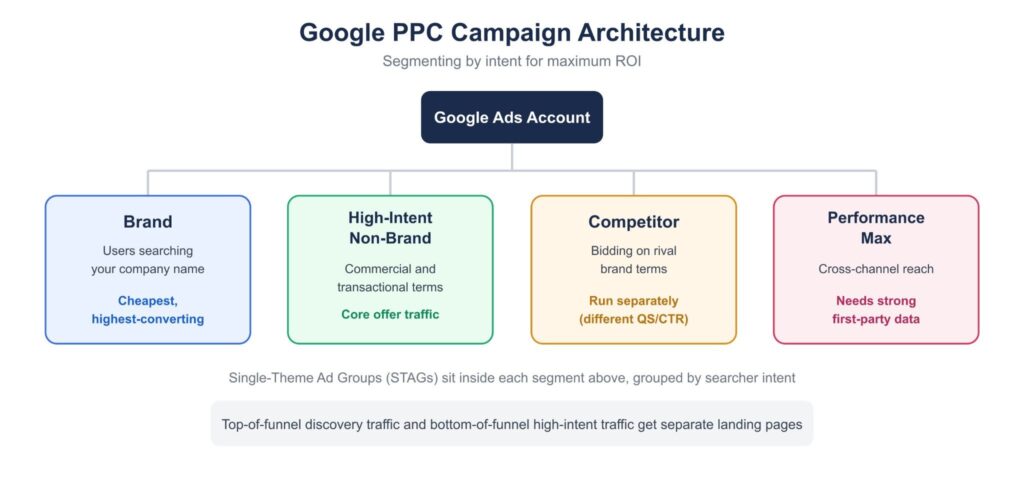
A well-structured account separates:
- Brand campaigns: capturing users already searching your company name (typically the cheapest, highest-converting traffic)
- High-Intent Non-Brand campaigns: commercial and transactional keywords tied directly to your core offer
- Competitor campaigns: bidding on rival brand terms, run separately due to different CTR and Quality Score expectations
- Performance Max campaigns: for cross-channel reach once first-party conversion data is strong enough to feed the algorithm reliably
Funnel Alignment
Not every keyword deserves the same landing page or the same bid strategy. Top-of-funnel discovery queries (“what is PPC advertising”) should route to educational content that nurtures trust. Bottom-of-funnel, high-converting search intent (“hire google ppc management services”) should route straight to a conversion-focused landing page with minimal friction. Blending these into one undifferentiated campaign is one of the most common reasons accounts underperform on cost per lead.
This distinction matters even more in b2b ppc campaign management, where sales cycles are longer and the wrong landing page can quietly cost a deal months down the line.
Step-by-Step: How to Set Up and Run a Google PPC Campaign from Scratch
Whether you’re building your first account or rebuilding one that’s underperforming, the sequence matters. If you’ve searched how to set up ppc campaign in google, how to run a google ppc campaign, or how to create a google ppc campaign from scratch, the answer starts with sequence, not shortcuts.
Step 1: Define Clear Campaign Goals and Conversion Actions
Before touching keywords, decide exactly what counts as a conversion: phone calls, form submissions, transactions, or scheduled demos. Set these up as tracked, verified conversion actions inside Google Ads before spending a single dollar. Every downstream decision, from bidding to budget allocation, depends on this data being accurate from day one.
Step 2: High-Intent Keyword Research and Match Type Mechanics
Build your keyword list around commercial intent first, then expand outward. Match type strategy has evolved:
- Exact and Phrase Match still give you the tightest control over which queries trigger your ads, ideal for protecting budget on your highest-value terms.
- Broad Match paired with Smart Bidding can uncover valuable query variations a human wouldn’t think to add manually, but only once your account has enough conversion history for the algorithm to bid intelligently. Turning on broad match too early, before conversion data exists, is a common way to waste budget.
Step 3: Build a Proactive Negative Keyword Strategy
Negative keyword lists should be treated as infrastructure, not an afterthought. Build layered negative lists: account-level exclusions for obviously irrelevant terms (jobs, DIY, free), plus campaign-level exclusions to prevent cannibalization between your own campaigns. This “gating” strategy is one of the fastest ways to protect spend before it’s wasted on unqualified clicks.
Crafting High-Converting Responsive Search Ads (RSAs) & Assets
Headline and Description Frameworks
Effective RSA copy does more than describe. It disqualifies the wrong searcher and speaks directly to the right one. Structure headlines around:
- The core offer (what you do)
- A specific differentiator (why you, not a competitor)
- A qualifier or proof point (pricing, guarantee, credential)
- A direct call to action
Descriptions should expand on the value proposition and pre-handle objections before the click ever happens.
Pinning vs. Algorithmic Testing
Google’s system will test headline and description combinations automatically, but leaving everything unpinned can produce grammatically awkward or brand-inconsistent ads. Pin your legally required or brand-critical assets (business name, core value proposition) and leave the remaining slots open for the algorithm to test and optimize. Good ppc campaign management does not stop at ad copy. It extends into how those assets are reviewed and refreshed over time.
Maximizing SERP Real Estate with Ad Assets
Sitelinks, callouts, structured snippets, image extensions, and lead form assets don’t just add information. They increase the physical size of your ad on the results page, improving expected CTR and, by extension, Quality Score. Pairing strong ad assets with the right approach to organic visibility compounds the results even further. See our piece on Grow Your Brand with Powerful Search Strategies for more.
Smart Bidding Strategies: When and How to Automate
Choosing the right bid strategy depends heavily on conversion volume and account maturity, not on which one sounds the most advanced. This is the core of any solid google ppc strategy: matching the bidding model to where the account actually is, not where you wish it were.
| Bid Strategy | Best For | Minimum Conversion Volume | Key Risk |
| Maximize Clicks | Brand-new accounts building data, or awareness-stage campaigns | None required | Can attract low-intent traffic |
| Maximize Conversions | Accounts with some conversion history, no fixed CPA target yet | 15 to 30 conversions/month recommended | May bid up to spend full budget |
| Target CPA (tCPA) | Accounts with steady conversion volume and a known acceptable cost per lead | 30+ conversions/month recommended | Underperforms with volatile conversion data |
| Target ROAS (tROAS) | Ecommerce or accounts tracking revenue value per conversion | 50+ conversions/month recommended | Needs accurate revenue tracking to work |
Smart Bidding is only as good as the data feeding it. This is precisely where ongoing google ppc management earns its keep: reviewing which conversions are actually qualified leads versus form spam, adjusting conversion values, and recalibrating targets as seasonality shifts, so the algorithm keeps optimizing toward revenue, not vanity clicks.
Landing Page Experience & Quality Score Optimization
Quality Score is built on three pillars, and each one has a direct, compounding effect on your actual cost per click:
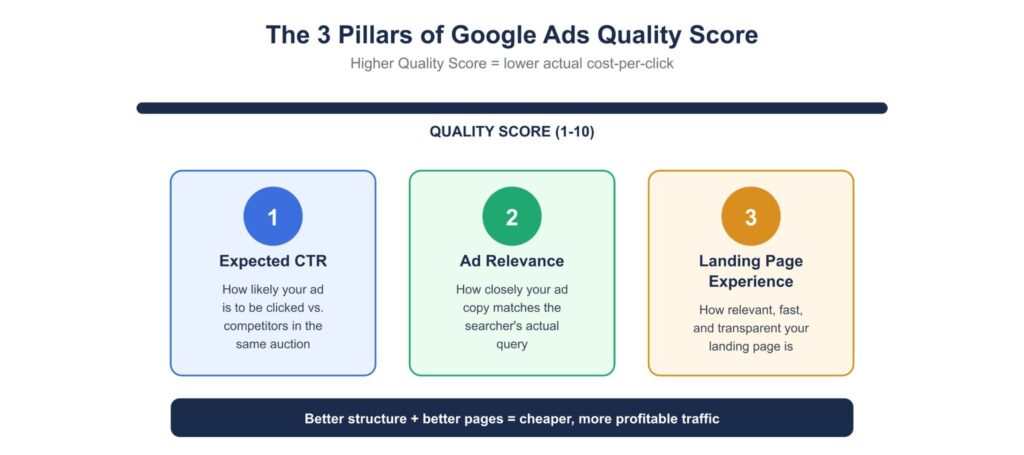
A higher Quality Score doesn’t just look good on a report. It directly lowers your actual CPC for the same ad position, meaning better structure and better pages translate straight into cheaper, more profitable traffic. Our Pay Per Click Services team focuses on exactly this, since Quality Score compounds savings across the entire account.
Critical Landing Page Conversion Elements
- Message match: the headline on your landing page should mirror the promise made in the ad
- Page speed: even a one-second delay in load time measurably increases bounce rate on paid traffic
- A direct value proposition above the fold, with no scrolling required to understand the offer
- A frictionless lead form: ask for the minimum information needed to qualify a lead, not the maximum information your sales team would like to have
Tracking, Analytics & Conversion Accuracy
Clean data is the single biggest lever most accounts leave on the table. Set up:
- Google Tag Manager (GTM) as the central hub for all tracking scripts and event triggers
- GA4 Key Events to capture the full customer journey, not just the last click
- Enhanced Conversions to match hashed first-party data (email, phone) against ad clicks, recovering conversions lost to browser privacy restrictions
- Offline Conversion Tracking (OCT) to sync CRM outcomes, like a lead that eventually closed as a sale, back into Google Ads, so the algorithm learns from real revenue, not just form fills
Without this layer, even the best campaign structure is optimizing against incomplete or misleading signals. This is the unglamorous side of google pay per click management, but it is often the difference between a campaign that plateaus and one that keeps improving.
Ongoing PPC Maintenance: The Weekly & Monthly Optimization Checklist
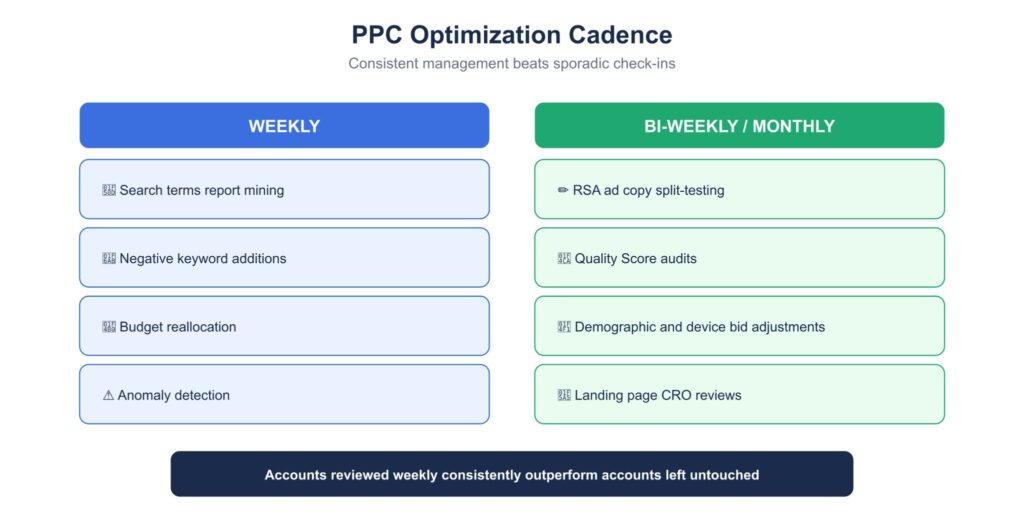
A Google PPC campaign is not a “launch and forget” asset. It requires a maintenance cadence, and this is where consistent google ppc management separates accounts that improve over time from accounts that quietly decay. Businesses that manage ppc campaigns well treat this checklist as non-negotiable, not optional housekeeping.
| Cadence | Task | Why It Matters |
| Weekly | Search terms report mining | Surfaces new negative keywords and untapped query opportunities |
| Weekly | Negative keyword additions | Prevents budget leakage on irrelevant clicks |
| Weekly | Budget reallocation | Shifts spend toward campaigns currently converting best |
| Weekly | Anomaly detection | Catches tracking breaks or sudden CPC spikes early |
| Bi-Weekly / Monthly | RSA ad copy split-testing | Keeps CTR and Quality Score improving over time |
| Bi-Weekly / Monthly | Quality Score audits | Flags ad groups drifting out of theme or relevance |
| Bi-Weekly / Monthly | Demographic and device bid adjustments | Concentrates spend on the segments that actually convert |
| Bi-Weekly / Monthly | Landing page CRO reviews | Ensures the page keeps pace with what the ads promise |
If this cadence sounds like more than your team has bandwidth for, you can Hire PPC Experts to absorb this ongoing workload without adding headcount.
In-House Management vs. Hiring a Google PPC Management Agency
Running a Google PPC campaign in-house is entirely possible, but it comes with real hidden costs: the learning curve on an unfamiliar platform, the software and reporting tools needed to monitor performance properly, and, most significantly, the opportunity cost of a marketing hire’s time spent on account maintenance instead of strategy.
Specialized Google Ads management services bring platform expertise across dozens of accounts and industries, meaning patterns and fixes that would take an in-house team months to discover through trial and error are often applied on day one. Agencies that need white label google ppc execution without building an internal team often partner with specialists rather than hiring in-house.
For agencies and businesses that need execution capacity without the overhead of a full internal team, many also round out their google ppc management offering with a Social Media Marketing Service, combining dedicated account strategy with the reporting and communication your clients or stakeholders expect, without the cost of building that capability from scratch.
Frequently Asked Questions
Q1. In-house vs. hiring a PPC agency: what’s the real difference?
An agency brings cross-account pattern recognition and dedicated time. In-house keeps direct control but has a steeper learning curve.
Q2. How long until a new campaign generates consistent leads?
Typically 4 to 8 weeks for Smart Bidding to gather enough data, with steady lead flow by month two or three.
Q3. How is Quality Score calculated?
From expected CTR, ad relevance, and landing page experience. Improve all three to lower your CPC.
Q4. Should I run PPC alongside SEO?
Yes. PPC delivers immediate visibility while SEO compounds lower-cost traffic over time, and the two channels reinforce each other.
Q5. Can I switch bid strategies mid-campaign?
Yes, but frequent switching resets the algorithm’s learning phase, so change strategies only when data clearly supports it.
Build It Right, Then Manage It Relentlessly
A profitable Google PPC campaign isn’t a one-time setup. It’s a system of tight account architecture, disciplined negative keyword hygiene, bidding strategies matched to actual data maturity, and landing pages built to convert what the ads promise. Get the structure right on day one, then commit to the ongoing review cycle that keeps it improving.
If you’d rather hand that ongoing work to a team that manages Google Ads accounts every day, claim a free Google Ads & PPC audit from Shreywebs and see exactly where your current account is leaking budget.