
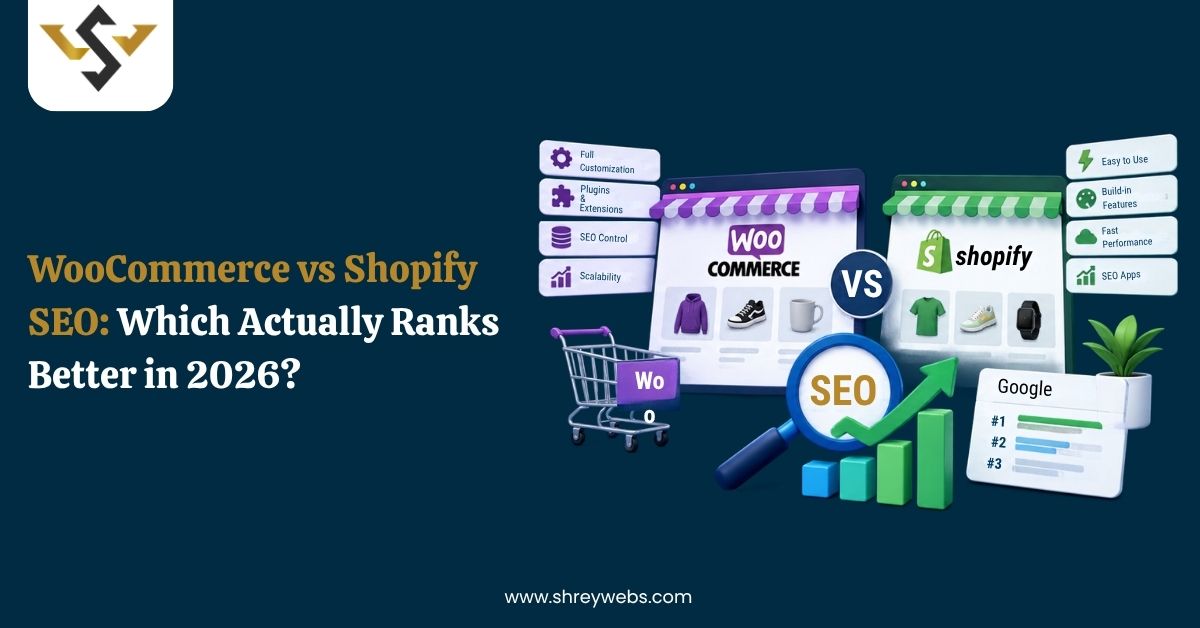
Every store owner we talk to eventually asks the same thing—which one actually wins, WooCommerce vs Shopify SEO? It’s a fair question, because the platform you pick shapes how much SEO work you’ll need to do later, not just how your store looks on day one.
There’s no universal answer, and anyone who settles this question without actually looking at your business is guessing. What we can do is break down where each platform genuinely helps or hurts rankings, so you decide with real information instead of forum opinions.
This isn’t theoretical either. We’ve handled E-commerce SEO Services for stores on both platforms, and the same patterns show up once a site crosses a few hundred products or starts competing for real search volume.
Shopify or WooCommerce for SEO: What Changes Under the Hood
The shopify or woocommerce for seo question comes down to control. Shopify is a closed, hosted platform—you get speed and stability out of the box, but you work inside its rules. WooCommerce runs on WordPress, so you get full flexibility, plugins included, but you carry more responsibility for keeping it fast and clean. This split is really the heart of every woocommerce vs shopify for seo debate we’ve had with clients.
For most Indian merchants, this distinction matters more than people expect:
- Shopify handles hosting, SSL, and CDN delivery automatically, with almost no setup.
- WooCommerce needs a good host and caching setup to hit similar speed.
- Shopify’s URL structure is rigid—you can’t remove /products/ or /collections/ from paths
- WooCommerce lets you customize permalinks fully, which helps with cleaner, keyword-rich URLs.
- Shopify apps can bloat page weight quickly if you’re not careful.
- WooCommerce plugins like Yoast or Rank Math give granular on-page control.
- Both platforms support canonical tags, schema, and sitemap generation natively.
Neither system is broken for SEO—each just asks something different of the person running the store, and that’s really what most woocommerce vs shopify seo debates miss.
Content and On-Page SEO: Where WooCommerce for SEO Often Pulls Ahead
If your growth strategy leans on blogging, buying guides, or long-form category content, that usually tilts you toward WordPress. It was built as a content system first, so internal linking, custom taxonomies, and structuring feel native rather than bolted on.
Shopify’s blog editor has improved, but it still feels secondary to the platform’s real focus—checkout and product pages.
We generally recommend teams serious about Boost Your Online Store visibility through content to weigh this early, before hundreds of pages are already built on one system.
A few things worth noting for on-page work:
- WooCommerce gives full control over title tags, meta descriptions, and header structure per page.
- Shopify’s theme editor restricts some of this unless you edit the theme code directly.
- WooCommerce supports faceted navigation control more easily, avoiding duplicate content from filters.
- Shopify’s collection filtering can quietly create thin or duplicate pages if left unmanaged.
- Both platforms index well once sitemaps are submitted correctly in Search Console.
Speed, Core Web Vitals, and Technical Performance in WooCommerce vs Shopify SEO
Here’s where the shopify vs woocommerce best for seo argument gets genuinely close. Shopify’s hosted infrastructure means most stores load fast by default. WooCommerce can match or beat that, but only with the right hosting, a lean plugin stack, and proper image optimization.
A poorly optimized WooCommerce store loads noticeably slower than default Shopify. But a well-built WooCommerce site, stripped of bloated plugins, often edges past Shopify on Core Web Vitals because you control every layer of the stack.
So shopify vs woocommerce best for seo isn’t really about which platform is faster in theory—it’s about which one your team can actually maintain well, and that’s the real fork in every woocommerce vs shopify seo decision.
Which Is the Best Ecommerce Platform for SEO India Businesses Should Pick?
For the best ecommerce platform for SEO India merchants specifically, budget, technical support, and content plans matter more than platform loyalty. A small D2C brand with one person managing everything often does better on Shopify—less to break. A larger catalog business planning heavy content usually gets more mileage from WooCommerce’s flexibility, which is exactly why woocommerce vs shopify for seo rarely has a one-size-fits-all answer. We’ve seen both work well and both fail—usually because the owner picked a platform based on what a competitor used, not what their team could manage.
WooCommerce tends to fit you better if your team already knows WordPress, content marketing is central to growth, or you need custom functionality no app covers. Shopify usually fits better if you want to launch fast without touching code, your catalog is small and product-focused, or your team has limited technical bandwidth. If you’re still unsure which way to lean, talking it through with an experienced Ecommerce SEO Company can save you from a costly platform switch later.
A Real Example Worth Learning From
One Ahmedabad apparel client came to us on Shopify with barely any organic traffic outside branded search. Their category pages were thin, and the blog hadn’t been touched in three years. We didn’t recommend a platform switch—we fixed the content gap and cleaned up collection duplication. Rankings improved within four months.
That’s usually the real lesson in most woocommerce vs shopify seo discussions. The platform sets the ceiling, but few stores are anywhere near it. Before assuming shopify or woocommerce for seo is your bottleneck, it’s worth auditing what’s actually holding your site back.
Our Take, Honestly
If we had to end the woocommerce vs shopify seo debate in one line, it’s this: the platform matters less than the discipline behind using it. We’ve ranked lean Shopify stores past bloated WooCommerce sites, and the reverse just as often.
If content and long-term flexibility matter more to you, WooCommerce rewards that investment. If speed and low maintenance matter more, Shopify usually serves you better. Getting expert help early saves you from rebuilding your foundation two years in.
Before committing either way, it’s worth running your setup through an Ecommerce SEO Checklist to see where the real gaps are—platform or otherwise.
Final Thoughts
There isn’t a single winner in the woocommerce vs shopify seo comparison, and any blog promising one is oversimplifying a decision that depends on your team, catalog, and growth plans. Shopify gives you speed and simplicity out of the box, while WooCommerce gives you control and content flexibility if you’re willing to manage it. The smarter move is picking the platform that matches how your business actually operates, then investing consistently in the fundamentals—content, structure, and site health—that move rankings regardless of which system you’re on.
Frequently Asked Questions
1. Is Shopify or WooCommerce better for SEO in general?
Honestly, neither wins outright. Shopify gives you speed and stability without much effort, while WooCommerce hands you deeper content and technical control if you’re willing to manage it. Where you land in the shopify vs woocommerce best for seo debate really comes down to your team and how much time you can put in.
2. Does switching platforms hurt existing rankings?
It can, but only if redirects and URL structures aren’t handled properly during the move. Do it right, and rankings usually bounce back within a few months—sometimes faster.
3. Which platform is the best ecommerce platform for SEO India small businesses should start with?
For most small Indian D2C brands running lean teams, Shopify tends to be easier to get going with. WooCommerce makes more sense once you’re planning serious content investment and have someone technical on board.
4. Can WooCommerce sites load as fast as Shopify?
They can, with decent hosting, proper caching, and a plugin list you actually keep in check. Skip that maintenance, and WooCommerce sites often end up slower than Shopify’s default setup.
5. Does blogging really make that much difference between the two?
It does, more than people expect. WooCommerce runs on WordPress, so blogging and internal linking feel built-in rather than added on. If content is going to carry your traffic long-term, that’s the real crux of most woocommerce vs shopify for seo comparisons.