
What Is Local SEO for Small Businesses?
Local SEO for small businesses is the process of optimizing a company’s online presence so it ranks higher in geographically relevant search results.
It’s built around the Google Map Pack and local organic listings. It combines Google Business Profile (GBP) management, on-page optimization, citation consistency, and review generation.
Most small business owners never see that definition play out on their own bottom line. They just notice that a competitor three blocks away shows up in the map results and they don’t.
That gap is rarely about quality. It’s about signals Google can measure and theirs can’t.
Here’s the part that should get your attention: over 60% of local searches on mobile now end without a single click to a website. The searcher gets everything they need from the Map Pack, the knowledge panel snippet, or the business’s Google profile directly.
If your business isn’t in that pack, you’re not losing a little traffic. You’re losing the customer before they ever reach your homepage.
This local SEO guide for small businesses walks through exactly how local SEO small business rankings actually work, what to fix first, and how to build a system that keeps producing results instead of a one-time spike. If you’d rather skip ahead to execution, our Local SEO Services page covers how we run this process for clients directly.
How Local SEO for Small Businesses Actually Works
SEO for local businesses is not the same discipline as traditional organic SEO, even though the two overlap.
Traditional SEO chases topical authority and backlink volume across a national or global audience. Small business local SEO—sometimes searched as SEO for small local business or local SEO small business—chases relevance to a specific place.
It’s judged by a different rulebook.
|
Factor |
Traditional Organic SEO |
Local SEO for Small Businesses |
|
Primary ranking surface |
Organic 10 blue links |
Map Pack (3-Pack) + local organic |
|
Core signal |
Domain authority, backlinks |
GBP + NAP + proximity |
|
Audience scope |
National / global |
City, neighborhood, service radius |
|
Content focus |
Topic depth, search intent |
Location pages, service-area pages |
|
Review influence |
Minimal ranking weight |
Direct ranking factor |
|
Search behavior |
Research, comparison |
“Near me,” urgent, transactional |
The 3 Pillars of the Local Algorithm
Google’s local ranking system weighs three factors when deciding which businesses to surface for a geo-intent query.
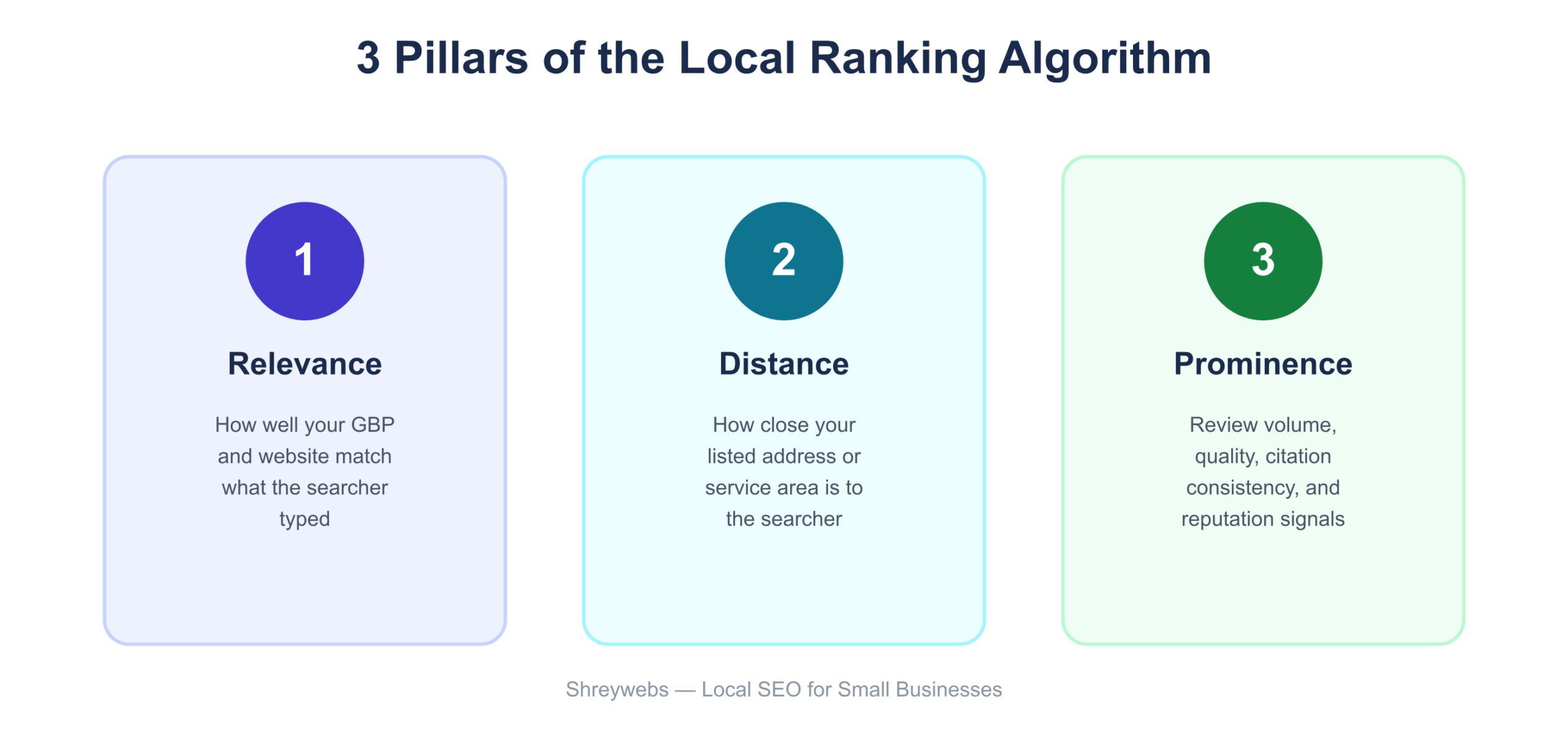
- Relevance—how well your GBP and website match what the searcher typed. A roofing contractor that lists “roof replacement” as a service will outrank one that only says “home improvement.”
- Distance—how close your listed address (or service area) is to the searcher, or to the location implied in the query (“plumber in Parramatta”).
- Prominence—how well-known and well-reviewed the business is, based on review volume, review quality, citation consistency, and offline reputation signals Google can detect online.
You can’t control distance for a walk-in customer searching from across town. But relevance and prominence are entirely within your control.
That’s exactly where local business SEO tends to pay off fastest.
The 5-Step Local SEO Process
Before diving into each step, here’s the full framework at a glance.
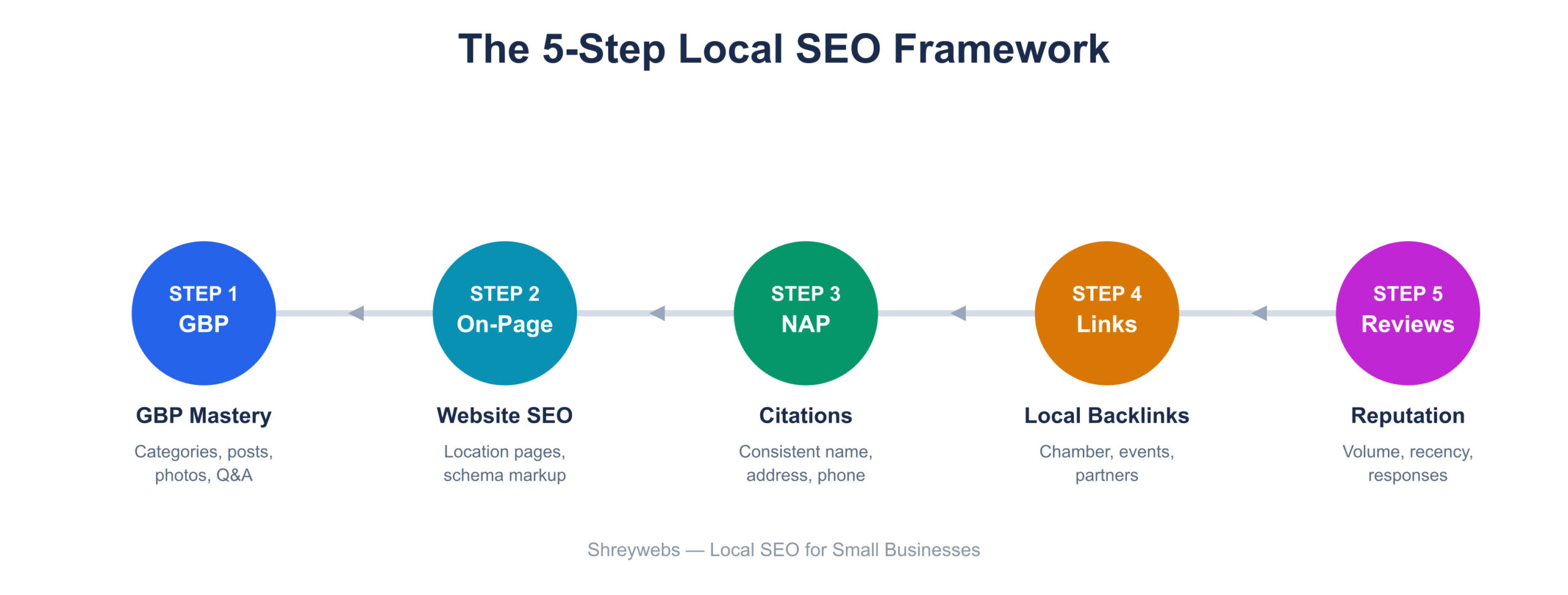
Step 1: Complete GBP Mastery
Your GBP is the single highest-leverage asset in local SEO for small businesses. Get it right and it becomes free, permanent real estate at the top of Google.
Neglect it and no amount of website work will compensate.
Businesses in Gujarat working with our SEO Company in Ahmedabad team usually start exactly here, since GBP fixes tend to show results fastest.
GBP Optimization Checklist
- Primary category first, secondary categories second. Choose the most literal match for your core service as primary (e.g., “Roofing Contractor,” not “General Contractor”), then add up to 9 relevant secondary categories.
- Full service menu with descriptions. List every service you offer as a distinct line item, not a single bundled paragraph.
- Geotagged photos and video. Upload images shot on-site with location metadata intact — Google reads this as a proximity and legitimacy signal.
- Weekly Google Posts. Short updates (promotions, project photos, seasonal tips) signal an active, maintained profile.
- Q&A section seeded proactively. Post and answer your own common customer questions before competitors or confused customers do it for you.
- Complete business description. Use your keywords naturally within the 750-character limit — don’t force every keyword variant into one paragraph.
- Accurate service area settings. For service-area businesses, list every city and region you actually cover, not just your home base.
Common GBP Mistakes That Trigger Ranking Drops (or Suspension)
- Stuffing keywords into the business name field (e.g., “Shrey Plumbing | Best Plumber Parramatta 24/7”) — this violates Google’s guidelines and risks suspension.
- Using a P.O. box or virtual office as a physical address for a business type that requires a storefront.
- Leaving the profile untouched for months — inactivity is treated as a weak prominence signal.
- Ignoring or generically responding to negative reviews instead of resolving them publicly.
Step 2: On-Page Local Website SEO & Architecture
Your GBP earns the click. Your website has to convert it.
That means local business SEO doesn’t stop at your profile. The site itself needs local signals baked into its architecture, not just its content.
This is the layer that most people running local search for a small business skip. It’s less visible than a GBP listing, but just as important for rankings.
Location Pages vs. Service-Area Pages
- Single-location businesses need one strong, detailed location page with embedded map, hours, service list, and localized content — not a generic “About Us.”
- Multi-location or service-area businesses need a dedicated page per city or region served, each with unique content, local testimonials, and location-specific service details. Thin, duplicated city pages (swap the city name, keep everything else identical) tend to get filtered out of rankings rather than helping.
Localized Metadata & Internal Linking
- Title tags should lead with the service and city: “Roof Replacement in Mandeville, LA | [Brand].”
- H1s should mirror the primary keyword phrase a searcher would actually type.
- Internal links from blog content should point to the most relevant location or service page using descriptive anchor text, not “click here.”
LocalBusiness Schema Markup Blueprint
Structured data helps Google parse your NAP, hours, service area, and review data directly from your code, reducing ambiguity. At minimum, implement:
- LocalBusiness (or a more specific subtype like RoofingContractor, Accountant, Plumber)
- name, address, telephone, openingHours, geo coordinates
- areaServed for each city or region covered
- aggregateRating and review markup, kept accurate and up to date
Step 3: NAP Consistency & Strategic Local Citation Building
NAP stands for Name, Address, Phone number. It needs to match exactly, character for character, everywhere your business appears online.
Inconsistent NAP data is one of the most common reasons for an otherwise well-optimized business plateaus in local rankings.
Clean, consistent local citations are what tie your NAP data back to a single, trusted business identity in Google’s eyes. They’re often the missing piece for businesses that have already handled the on-page basics of SEO for local business.
Data aggregators like Data Axle, Neustar Localeze, and Foursquare feed business information to dozens of downstream directories and apps. Getting your NAP correct at the aggregator level prevents bad data from propagating for years.
As search shifts toward AI-generated answers, this same consistency also feeds into AEO and GEO Services, since AI assistants pull from the same citation data when recommending local businesses.
Core Directory Checklist
|
Category |
Examples |
Priority |
|
Data Aggregators |
Data Axle, Neustar Localeze, Foursquare |
Fix first — feeds everything downstream |
|
General Directories |
GBP, Bing Places, Apple Maps, Yelp |
High — direct consumer-facing |
|
Industry Verticals |
HomeAdvisor/Angi (contractors), Avvo (legal), Healthgrades (medical) |
Medium — builds topical trust |
|
Local Directories |
Chamber of Commerce, local business associations |
Medium — supports prominence and backlinks |
Step 4: Local Backlink Building for Small Business
Backlinks still matter for local SEO, but the sources that move the needle are different from a national campaign.
You don’t need a mention in a national outlet — you need links from sources Google associates with your city. This is where local SEO for small businesses really diverges from a broader national link strategy.
- Local chamber of commerce and business association sponsorships — often include a member directory link as part of the package.
- Community event sponsorship or hosting — local news sites and event pages routinely link back to sponsors.
- B2B supplier and partner cross-linking — if you use a local supplier, ask about a “our partners” or “who we work with” page link.
- Local resource list curation — build a genuinely useful local resource (e.g., “Storm Prep Checklist for Louisiana Homeowners”) that local news, schools, or community groups want to link to.
- Scholarship or sponsorship link building — small, low-cost local scholarships are still an effective, low-competition way to earn .edu and local press links.
These tactics work well for businesses running local SEO in-house on a limited budget. They’re exactly the kind of ongoing outreach agencies handle through white label local SEO services or a reseller SEO arrangement, since consistent execution matters more than any single placement.
Step 5: Review Generation & Reputation Management
Reviews are a direct, measurable ranking input for local search, not just a trust signal for human visitors.
Google factors in review volume, recency, rating, and keyword-rich content within the review text itself. Of all five steps, this is the one most owners doing SEO local business work underinvest in, even though it’s often the fastest to move.
Review Acquisition Workflow
- Ask at the moment of highest satisfaction — right after a completed job or delivered service, not days later.
- Send a direct, one-click review link via text message; SMS request completion rates consistently outperform email.
- Make the ask specific: “If you have a minute, mentioning what service we completed helps other homeowners find us.” This naturally encourages keyword-rich reviews without scripting them.
- Set a recurring cadence (weekly or biweekly) rather than a one-time push, since recency matters as much as total volume.
Review Response Templates
Positive review: “Thanks for taking the time to share this — we’re glad the [service] worked out well and appreciate you trusting us with it.”
Negative review: “We’re sorry to hear this didn’t meet expectations. We’d like to make it right — please reach out to us directly at [contact] so we can resolve this.”
Responding publicly and promptly to negative reviews, without being defensive, tends to reassure future customers more than a perfect rating with no responses at all.
For a broader look at how visibility on Google translates into actual customers, this piece on how small businesses can win more customers through Google Search is worth a read.
Local SEO for Small Business Examples
Here’s how these principles play out for a small retailer, an SMB service provider, and a multi-location business. Each one applies local search for small business fundamentals in a slightly different way.
Physical retail store / boutique: Local SEO for small retailers often starts here. A local clothing boutique restructured its GBP categories from generic “Clothing Store” to a more specific primary category.
It added weekly product-drop posts with geotagged photos and began requesting reviews at checkout. Map Pack visibility for “boutique near me” queries improved as review volume and post frequency increased.
Service-area business (plumber/electrician): A residential electrician with no storefront relied entirely on service-area settings in GBP, combined with individual landing pages for each of the six cities served.
Each page included locally specific content — permitting requirements, common local wiring issues — rather than duplicated boilerplate. This helped multiple city pages rank independently instead of competing with each other.
Multi-location SMB: A regional accounting firm with three office locations consolidated near-duplicate city pages into fewer, deeper pages covering clusters of nearby suburbs.
It kept a dedicated page for each city where the firm had a genuine ranking opportunity and physical presence. This matches the kind of consolidated-versus-split landing page decision most multi-location businesses eventually have to make when running local small business SEO across several markets at once.
Frequently Asked Questions
Q1. Where should a small business start with local SEO?
Start with your GBP — claim it, verify it, complete every field, and get a few genuine reviews before anything else.
Q2. How long does local SEO take to start ranking in the Map Pack?
Usually 60–90 days for early movement, four to six months for stable gains in competitive markets.
Q3. Can a service-area business rank locally without a physical storefront?
Yes — set an accurate service area in your GBP and build a dedicated page per city served.
Q4. What’s the difference between local SEO and local SEM (PPC)?
Local SEO earns organic Map Pack placement over time; local SEM buys it instantly through ads.
Q5. Should I handle local SEO in-house or bring in an agency?
In-house works if someone can commit real weekly hours. Otherwise, a white-label local SEO partner like Shreywebs is more consistent.
Final Takeaway Checklist
- [ ] GBP fully completed, verified, and categorized correctly
- [ ] Weekly GBP posts and geotagged photo uploads scheduled
- [ ] NAP consistency confirmed across data aggregators and top directories
- [ ] Location or service-area pages built with unique, locally specific content
- [ ] LocalBusiness schema markup implemented and validated
- [ ] Local link building outreach underway (chamber, events, partners)
- [ ] Review request workflow automated and running on a recurring cadence
Local SEO for small businesses isn’t a single fix, it’s a system: GBP, on-page architecture, citations, links, and reviews, all reinforcing each other over time.
Whether your team calls it local SEO small businesses, SEO local businesses, or just local search, the mechanics are the same.
Businesses that treat it as a one-time project tend to plateau. Businesses that keep the system running keep climbing.
If you’re comparing costs, our SEO Packages in India page breaks down what’s included at each tier.
If you’d rather have this handled end to end, Shreywebs offers a free Local SEO audit for small businesses, along with white-label Local SEO fulfillment for agencies that want to offer local SEO for small businesses without building an internal team. Request your free audit and get a free quote →